
Furnace repair, and the safety checks that come with it
A furnace that will not stay lit is being shut down by a safety control doing its job. Where in the startup sequence it stops tells you a great deal about what failed, which is why we ask about that on the phone before anyone gets in a truck.
Before anything else
If you smell gas: do not touch light switches, appliances or a phone inside. Get everyone out, call your gas utility from outside, and only call us once they have made the property safe.
If a carbon monoxide alarm sounds: get everyone outside into fresh air and call 911 or the fire department. Do not go back in to investigate. A sounding CO alarm around a furnace is exactly the scenario the alarm exists for.
How far does it get before it stops
A furnace runs the same startup sequence every time: the thermostat calls, the inducer fan clears the flue, a pressure switch confirms it, the igniter heats, the gas valve opens, a flame sensor proves the flame, and only then does the blower start. Whichever step it fails at points at a different component.
Startup sequence check
Stand near the furnace, turn the heat up, and watch what happens. Pick the point where it stops.
This narrows the likely cause. It is not a repair instruction, and nothing here involves opening a gas train or touching wiring. If the furnace has locked out, resetting it more than once is worth avoiding, particularly on oil, where repeated resets can flood the combustion chamber.
The combustion side is not optional
Anything that burns fuel inside a house gets checked for how safely it is burning, not just whether it is running. That is the part of a furnace visit that separates a repair from a part swap.
- Heat exchanger inspection. A crack lets combustion gases into the air you breathe. If we find one, the unit gets shut down. It is not a judgment call and it is not repairable.
- Combustion and venting. Flue condition, draft, and that the exhaust is going where it should rather than spilling back into the room.
- Gas pressure and temperature rise. Measured against the manufacturer's spec rather than assumed. A furnace running outside its temperature rise range is stressing the heat exchanger.
- Safety controls tested. Limit switches, rollout switches and the pressure switch verified as working, not bypassed to get you through the night.
- Airflow and filter. Restricted airflow overheats a furnace and trips it on the high limit, which is one of the most common causes of a call that looks like a control fault.
- Verification before we leave. A full cycle watched through from call to blower shutdown.
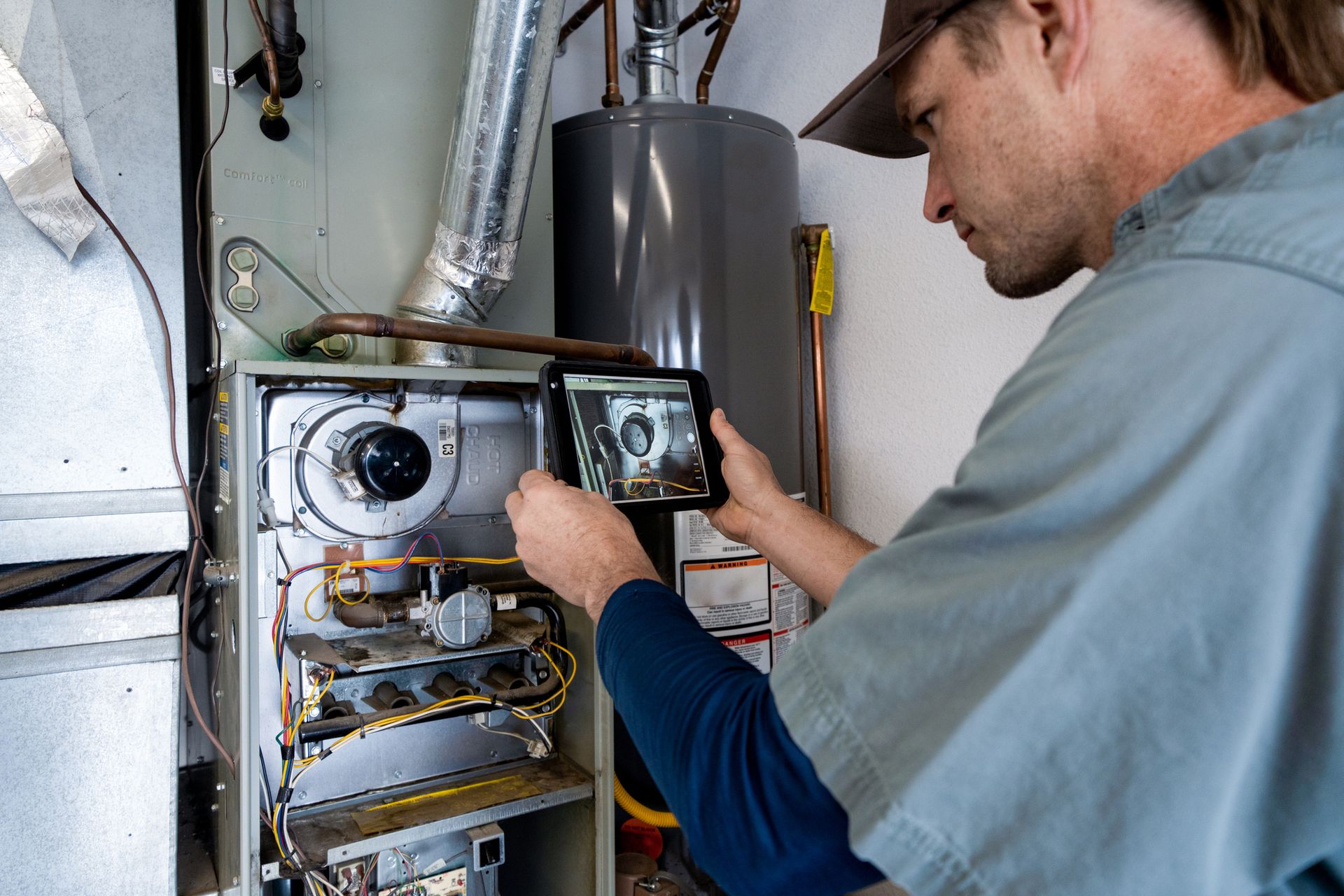
They fail in different ways
Most of the startup sequence is common to all of them, but what tends to go wrong is not.
- Gas and propane furnaces most often fail at ignition or flame proving. Hot surface igniters are a wear item, and a dirty flame sensor is one of the most common no-heat calls of the season. Both are inexpensive parts with dramatic symptoms.
- Oil furnaces bring their own list: nozzles, electrodes, the oil filter, and the pump. They also lock out more readily, and the reset button is the thing people press repeatedly. Doing that floods the chamber and turns a service call into a longer one.
- High efficiency condensing units add a condensate drain that can block and trip a pressure switch, which presents as a furnace that will not start for no obvious reason.
- Older equipment of any fuel gets harder to source parts for, and that eventually decides the repair or replace question on its own.
When we will tell you to stop repairing it
Most furnace faults are worth fixing. A few are not, and we would rather say so on the first visit than on the third.
Fix it and move on
Igniters, flame sensors, capacitors, pressure switches, thermostats, blower capacitors and drain blockages. These are wear items on equipment of any age, they are inexpensive relative to a replacement, and fixing one buys you seasons rather than weeks.
Repair stops making sense
A cracked heat exchanger, which is a hard stop. A repair approaching a third of replacement cost on a unit past fifteen years. A third significant failure in as many years. Or parts that are no longer available for the model.
If it is replacement time. A furnace forced in January limits you to what can go in that day. Planned in a shoulder season you get to compare a like-for-like furnace against the electrify routes, and on oil or propane the state rebate programs pay their largest incentives to move away from delivered fuel.
Hunter was timely, thorough, informative, polite, honest, and detailed. He offered options while thinking long term. I appreciated his demeanor and would recommend him and the company to my own family as well as others! Great experience!
Sheri BartlettGoogle reviewFurnace repair questions
Tell us where it stops
What fuel it burns, roughly how old it is, and how far it gets through the startup before it quits. If you have no heat right now, calling is faster and someone is answering.
Next steps and neighbors
No heat? Call now
We diagnose the fault, check how safely it is burning, and price the repair before touching anything.